Estimate vs Quote vs Invoice: Which One to Send and When

A customer asks how much the job will cost. You can answer with an estimate or a quote, and once the work is done you send an invoice. Plenty of people use the three words as if they meant the same thing, and that’s where a lot of billing arguments start: the customer reads your estimate as a promise, and then the invoice arrives $400 higher with no explanation.
Below is what each one is for and how to get from the first number to the final bill without an awkward phone call.
The short version
| Estimate | Quote | Invoice | |
|---|---|---|---|
| What it is | Your best guess at the cost | A fixed price for a defined job | A request for payment |
| When you send it | Before the job, when you can’t see it all yet | Before the job, when you know exactly what’s involved | After the work, or partway through as agreed |
| Can the price change? | Yes, within limits you explain | Only if the job changes | Only with a credit note or a new invoice |
| Is it a bill? | No | No, apart from any deposit | Yes |
These meanings come from common business use. In most places the labels aren’t defined by law, so what the document actually says matters more than the word at the top. A few industries are an exception, and we’ll get to those.
Estimate: a best guess with room to move
Send an estimate when you can’t know the full cost until you start. A plumber doesn’t know what’s behind the wall, and a mover can’t tell how much a narrow staircase will slow the crew down.
A useful estimate lists the work line by line, states what you assumed, and says how far the final price could move and why. “Between $1,200 and $1,600, depending on the condition of the pipe behind the wall” is far easier to defend later than a single number. Add a date after which the estimate no longer applies, because material prices and your schedule both change.
Quote: a price you commit to
Send a quote when the job is clear enough that you’re willing to stand behind one number. The customer will hold you to it, so the scope has to be written down: what’s included, what isn’t, how long the price is valid, and how payment works. If you take a deposit, say how much and when it’s due.
Once the customer accepts a quote, treat the price as fixed for that scope. When they ask for something extra halfway through, don’t quietly add it to the bill. Write a short change order with the new item and its price, get a yes in writing (a text or email is usually enough for small jobs), and keep it with the quote.
Invoice: the request for payment
The invoice comes after the work, or at a milestone you agreed on. It’s the document that says “pay this amount by this date.” It needs a unique invoice number, the invoice and due dates, the line items, any deposit already paid and the balance due.
Some customers need something that looks like an invoice before the work starts, for example to get a purchase approved or to clear customs. That’s a proforma invoice, and it’s closer to a quote than a bill.
When the words have legal weight
In some trades, the rules about estimates are written into law, and the invoice has to follow them.
Interstate moves in the US. Movers give either a binding or a non-binding estimate. Under a binding estimate, the customer pays the agreed price, plus any services they add. Under a non-binding estimate, the mover can’t require more than 110 percent of the estimate at delivery and bills anything above that after 30 days. The FMCSA’s Protect Your Move page has the booklet movers must hand to customers.
Auto repair in California. Shops must give a written estimate for parts and labor and can’t charge more without the customer’s consent, which has to come before the extra work is done. If the customer agrees by phone, the shop writes down who approved it and when, then either notes it on the invoice or has the customer initial an acknowledgment. The details are in section 9884.9 of the Business and Professions Code.
Other states have similar rules for car repair and home improvement work, and they differ on the amounts and the paperwork. If you work in one of these trades, check with your state’s consumer protection office before you write your estimate template.
From estimate to invoice without a fight
Most disputes over a final bill come down to surprise. The customer saw one number, then got another, and nobody told them why. A few habits fix most of that.
- Use the wording and order from the estimate or quote, so the customer can check one against the other in a minute.
- Put the reference number on the invoice. “For work in quote Q-0098” tells the customer, and your bookkeeper, which agreement the bill belongs to.
- Give each change its own line with a note on who approved it, such as “Second bathroom fan, approved by text on Oct 14.”
- Show the deposit as already paid, so the balance is the only number the customer has to act on. Our guide on how to ask for a deposit has wording for that part.
- If the total is higher than the estimate, call or message the customer before you send it and say why. The invoice shouldn’t be the first they hear of it.
Wording you can copy
On an estimate: “This estimate is based on what we can see today. The final price could be up to 15% higher if the subfloor needs repair. We’ll ask before doing any work that isn’t listed here.”
On a quote: “This is a fixed price for the work listed above and is valid until November 30. Anything not listed will be quoted separately before we start it.”
On an invoice: “Invoice INV-0142 for the work in quote Q-0098, completed on October 24. Deposit of $500 received. Balance of $1,250 due by November 7.”
If the invoice still goes unpaid, our day-by-day plan for unpaid invoices picks up from there.
Invoice templates that keep the reference
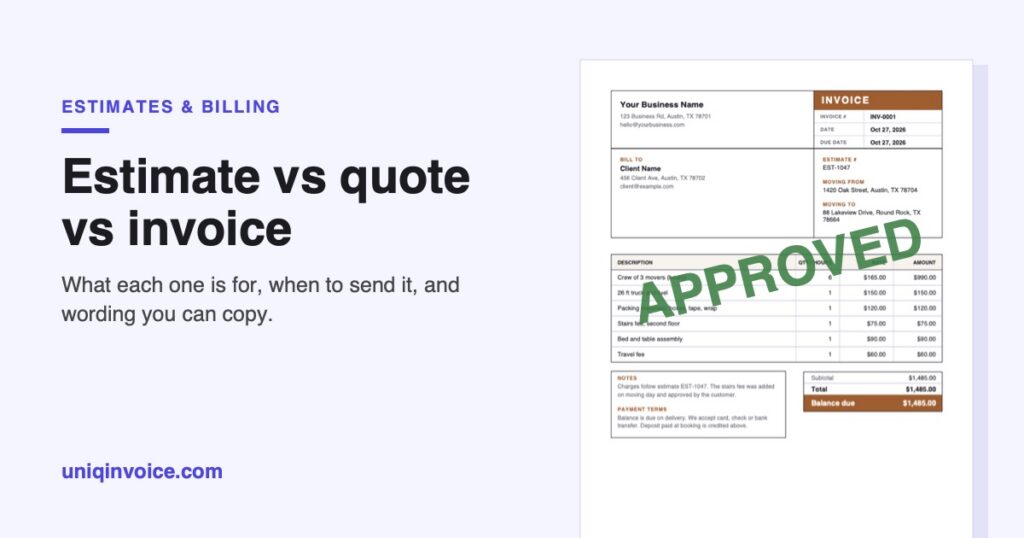
Our moving company invoice template has an Estimate # field next to the pickup and delivery addresses. The contractor template is set up for jobs priced from a quote, and the auto repair template separates parts from labor the way most repair estimates do. All of them are free and download as a PDF.
Quick answers
Is a quote legally binding?
Often, once the customer accepts it, because an accepted quote can work as an agreement on price for that scope. How far that goes depends on the wording and on local law. Spelling out the scope and an expiry date protects both sides.
Can the invoice be higher than the estimate?
Yes, that’s the point of an estimate, but explain the difference and get approval before doing extra work. In trades with specific rules, like interstate moving and auto repair in some states, the limits are set by law.
Should I charge for an estimate?
For simple jobs, most businesses don’t. When an estimate takes real work, like a site visit or a diagnostic check on a car, many charge a small fee and take it off the final invoice if the customer goes ahead.
Do I need a separate document for each step?
For small jobs, a quote and an invoice are usually enough. Larger or less predictable work goes better with an estimate first, a quote once the scope is settled, and change orders in between. Use the same customer details and numbering on all of them, and the paper trail mostly takes care of itself.