Progress Billing: How to Invoice a Project in Stages

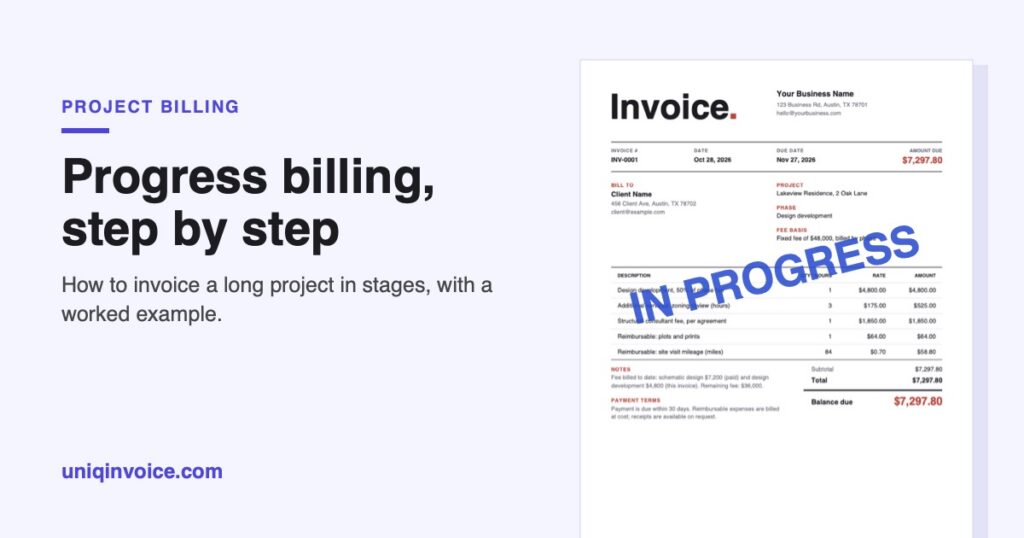
If a project takes four months and you send one invoice at the end, you’ve spent four months covering materials and wages before the client pays a cent. Progress billing fixes that. You agree on a total up front, then invoice for the part of the work that’s done as the project moves along.
Contractors have billed this way for a long time, but it works just as well for architects or developers on long projects. Here’s how to set it up, with a worked example you can copy.
What progress billing means
With progress billing, one contract gets several invoices. Each one bills the share of the work completed since the last invoice, and by the end of the project they add up to the full contract amount. It’s different from a deposit, which is paid before any work starts. Many projects use both: a deposit to book the job, then progress invoices as it moves forward. Our guide on how to ask for a deposit covers the first part.
Three ways to set the stages
By milestone
You bill a fixed amount when a defined piece of work is finished, such as an approved design or a framing inspection that passed. It’s simple to explain and easy for the client to check. Architects often bill this way by design phase.
By percentage complete
The contract is broken into lines, and each invoice bills how far each line has progressed. If cabinets are worth $16,000 and half of them are installed, you bill $8,000 for that line. This is the usual method in construction, and it’s what the AIA G702 and G703 payment forms are built around.
By billing period
You invoice on a set date, usually monthly, for whatever was completed in that period. It pairs well with either of the methods above and gives the client a predictable rhythm.
Agree on the schedule before you start
Progress billing only works if both sides agreed on the stages first. In construction this list is called a schedule of values: each part of the job with its share of the price. Here’s one for a $40,000 kitchen remodel.
| Demolition and prep | $3,000 |
| Rough plumbing and electrical | $8,000 |
| Cabinets and countertops | $16,000 |
| Flooring, tile and paint | $9,000 |
| Fixtures, cleanup and punch list | $4,000 |
| Contract total | $40,000 |
Write down how progress will be measured and who signs off on it, and put the payment terms in the same document. If a lender or project manager approves payments, ask what they’ll need to see before the first invoice goes out, not after it’s rejected.
What each progress invoice should show
A progress invoice needs more than the amount due this month. The client wants to see where the whole contract stands, so include the running totals. Say the remodel above is in its second month. Demolition and rough-in are done, half the cabinets are in, and the client approved a $1,500 change order for extra outlets, which is also finished. The first invoice billed $11,000, and the contract holds back 10% retainage.
| Original contract | $40,000 |
| Approved change orders | $1,500 |
| Contract to date | $41,500 |
| Work completed to date | $20,500 |
| Retainage held (10%) | -$2,050 |
| Earned, less retainage | $18,450 |
| Previously invoiced, less retainage | -$9,900 |
| Amount due this invoice | $8,550 |
| Balance left, including retainage | $23,050 |
Work completed to date is $3,000 for demolition, $8,000 for rough-in, $8,000 for half the cabinets and $1,500 for the change order. Last month’s invoice covered $11,000 of work, minus $1,100 retainage, so $9,900 was billed. The difference is this month’s payment. Put the line-by-line detail on the invoice or attach it, so the client can check every number against the schedule.
Retainage: the part you get at the end
Retainage is a percentage of each payment the client holds back until the job is finished, as a guarantee that you’ll come back for the punch list. It’s common in construction and rare elsewhere. The amount comes from the contract, though some rules cap it. On federal construction contracts, FAR 32.103 limits it to 10 percent and says it should be paid promptly once the work is complete. California caps retention on most public works contracts at 5 percent under Public Contract Code 7201. Rules for private projects vary by state.
Track retainage on every invoice, and send a separate invoice for the released amount when the job is done. Retainage is easy to forget when it’s been sitting in a column for months, and on a job with thin margins it can be most of your profit.
Handling changes mid-project
When the client asks for extra work, get the price approved in writing, then add it to the schedule as its own line. Bill progress on it the same way as the rest, as the extra outlets were in the example. Don’t fold it into an existing line, because then the numbers stop matching the original schedule and every later invoice gets harder to check. We cover change orders in more detail in estimate vs quote vs invoice.
Mistakes that slow down payment
The one clients notice fastest is billing ahead of the work. Claiming 50% on cabinets when a third are installed may help cash flow this month, but once a client or lender catches it, they’ll question every invoice after that. Bill what’s actually done, even when that makes for a smaller invoice.
Totals that don’t match are the next problem. If the “previously invoiced” line doesn’t agree with what you actually sent, the client has to stop and reconcile before they can approve anything. Keep the same invoice numbering and carry the totals forward from the last invoice instead of retyping them. Change orders left unbilled until the end cause the same kind of delay, because a pile of extras on the final invoice is the easiest thing for a client to dispute.
If a progress invoice still goes unpaid, our day-by-day plan for unpaid invoices walks through what to send and when.
Templates for staged projects
Our architecture invoice template bills design fees by phase and keeps the fee billed to date in the notes. For building work, the construction template and the contractor template list labor and materials line by line, so you can match them to your schedule. All of them are free and download as a PDF.
Quick answers
Is progress billing the same as milestone billing?
Milestone billing is one kind of progress billing. Progress billing is the broader idea of invoicing a project in parts, whether you split it by milestone, by percentage or by month.
What if the client disagrees with the percentage complete?
Settle how progress is measured before the job starts, and back up each invoice with photos or a quick site walk. If you still disagree on one line, bill the lines you agree on and sort out the disputed one separately, so the whole invoice isn’t held up.
Can freelancers use progress billing?
Yes. A $9,000 website could be billed as $3,000 at the start, $3,000 when the design is approved and $3,000 at launch. The first payment is really a deposit, and the other two are milestones.
How often should I send progress invoices?
Monthly is the most common on long projects, and it’s what many lenders and general contractors expect. On shorter jobs, billing at each milestone is usually enough. What matters most is that the client knows the schedule in advance and that each invoice shows the running total.