How to Ask for a Deposit (and Invoice It) Without Losing the Client
You quote $6,000 for a website. The client says yes. You’re about to block out three weeks of your calendar, turn down another job and start work on Monday. If they disappear halfway through, every hour you spent is your loss.
That’s what a deposit is for. Your early costs are covered before you start, and you find out on day one whether this client pays invoices when they arrive. Plenty of freelancers and small businesses still skip it because asking feels awkward, which is a shame, because the asking is the easy part once you’ve done it twice. Here’s how much to ask for and the wording we’d use.
How much deposit to ask for
For most service work there’s no legal standard. The right number depends on your risk. For project work, 25 to 50 percent up front is common. Go toward 50 when you’ll spend money before the client sees results, when the project is long, or when you don’t know the client yet. Go lower for repeat clients who have always paid.
If the job needs materials, the deposit should at least cover them. Contractors ordering cabinets and caterers buying food for 120 guests shouldn’t be financing someone else’s project out of pocket. For small jobs, a deposit can be more trouble than it’s worth; for a few hundred dollars of work, many people simply ask for full payment up front or invoice on completion.
Long projects work better with a deposit plus milestone payments than with one large deposit. Thirty percent to start, thirty at a midpoint the client can see, and the rest on delivery keeps cash coming in and keeps the client engaged.
Doing home improvement work? Check your state’s limits
Some states cap deposits for home improvement contracts, and the caps are lower than many contractors expect. In California, the down payment generally can’t be more than $1,000 or 10 percent of the contract price, whichever is less, according to the Contractors State License Board. On a $40,000 kitchen remodel, that’s $1,000, not $4,000. In Massachusetts, the state’s home improvement contractor guide says a deposit generally can’t exceed one-third of the contract price, with an exception for special-order materials. Other states have their own rules, so check before you write the contract.
Deposit, retainer or down payment?
People use these words loosely. That’s how arguments start. In most contracts, a deposit or down payment is part of the total price, paid early and credited against the final bill. Retainer can mean two different things: money held and drawn down as you work (common for lawyers and consultants), or a fee that reserves your time and isn’t refundable (common for wedding photographers and planners).
Whatever you call it, write down two things in the contract or proposal: whether it counts toward the total, and whether the client gets it back if they cancel. “Non-refundable” in the terms only helps you if the client saw it before they paid.
How to ask for a deposit without sounding apologetic
Put the deposit in the proposal, next to the price, before the client agrees to anything. When it’s part of the offer, it reads as how you work. When it shows up after the handshake, it reads as a new demand.
In a proposal or quote, one plain line is enough:
Total project price: $6,000. A 40% deposit ($2,400) reserves your start date of May 4. The balance is due on delivery.
When the client accepts, send the deposit invoice right away, with a short email:
Hi Jordan, great to be working together. Attached is the deposit invoice for $2,400 (40% of the $6,000 project). Once it’s paid, I’ll lock in May 4 as the start date and send over the kickoff questions. You can pay by card or bank transfer from the link on the invoice. Thanks, Alex
Notice what that email doesn’t do. It doesn’t apologize, explain your cash flow, or ask whether a deposit is okay. It ties the payment to something the client wants, the start date, and moves on.
How to invoice a deposit
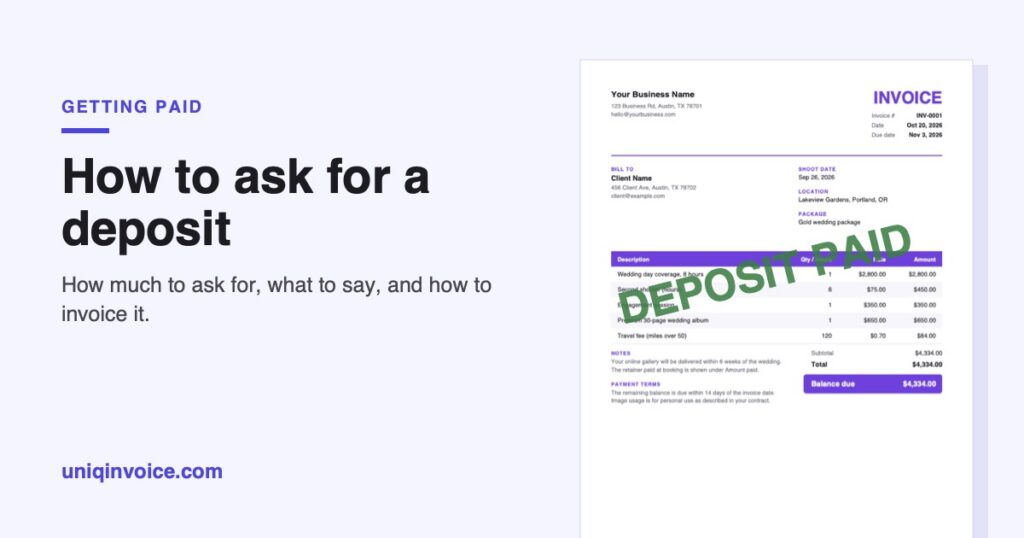
The cleanest way is two invoices: one for the deposit now and one for the full job at the end, with the deposit subtracted. Using the same $6,000 project:
| Invoice | What it shows | Amount due |
|---|---|---|
| INV-1051, sent on acceptance | “Deposit: 40% of website redesign, per proposal dated April 20” | $2,400 |
| INV-1058, sent on delivery | Every line of the project ($6,000 total), then “Amount paid: $2,400 (deposit, INV-1051)” | $3,600 |
Listing the full scope on the final invoice matters. It gives the client one document that shows everything they bought and everything they paid, which is what their accountant will want, and it makes a later dispute much easier to settle. Referencing the deposit invoice number avoids the “did we already pay this?” email.
Two money details to check with your accountant. Whether sales tax applies to a deposit depends on your state and on what you sell. And if you use accrual accounting, a deposit usually sits on your books as a liability until you’ve done the work, not as income the day it arrives.
Our free invoice templates have an Amount paid field for exactly this, so the balance due updates on its own. The contractor, photography and event planner templates also explain how deposits and retainers usually work in those trades.
When the client pushes back
Most pushback is about cash timing, not trust. You can lower the deposit and add a milestone payment, so the total risk stays the same. You can accept card payments, which lets the client spread the cost on their side. Or you can keep the deposit and move the start date until it’s paid, which is fair to the other clients waiting for that slot.
If a new client refuses any upfront payment on a large project, treat that as information. Someone who won’t commit $1,000 before work starts is unlikely to be easier to collect from after it’s done. Our guide on what to do when a client won’t pay covers what happens when that goes wrong.
Quick answers
Is a deposit refundable?
It depends on what your contract says and, for some industries, on state law. If you want it to be non-refundable, say so in writing before the client pays, and keep it reasonable relative to the work or costs it covers.
Should I ask every client for a deposit?
Not necessarily. Many businesses ask every new client and drop the deposit for repeat clients with a good payment history. Small jobs are often simpler to bill in full, either up front or on completion.
What’s the difference between a deposit invoice and a proforma invoice?
The deposit invoice asks for an actual payment now. A proforma invoice is a preliminary version of the final invoice, used for quotes, internal approvals or customs. It isn’t a final tax invoice, even when a buyer pays against it in advance. See our guide to proforma invoices for more.
The first deposit request is the uncomfortable one. After that it becomes a line in your proposal, like the price and the start date, and clients treat it that way too. The ones who pay it promptly have already shown you how they handle invoices. The ones who argue about it have shown you something as well, before you’ve done any work.