How to Calculate Your Freelance Hourly Rate (From the Salary You Want)
Most people set their first freelance rate the same way: take the salary they had, divide it by 2,080 working hours, and round up a little. On an $85,000 salary that gives you about $41 an hour. It feels reasonable. It’s also less than half of what you need to charge to end up with the same money.
The gap is everything an employer used to pay for without you noticing: the costs of running the business, half of your payroll taxes, and every hour you’re at work but not doing work someone pays for. Put those back in and the number changes fast. Here’s the math, worked through with real figures you can swap for your own.
Step 1: Start with the income you want
Pick the yearly amount you’d want as a salary if you were doing this job for someone else. Not a stretch goal, the number you’d accept. We’ll use $85,000 for the example.
Step 2: Add what the business costs to run
Write down everything you pay for that an employer would have covered. For a typical solo freelancer that might look like this, though your numbers will be different:
- Software and subscriptions: $1,800
- Laptop and equipment, spread over three years: $1,000
- Health insurance, if you buy your own: $6,000
- Business and liability insurance: $600
- Accountant or tax software: $1,200
- Business share of phone and internet: $900
- Retirement savings to replace an employer match: $2,500
That adds up to $14,000 a year. Health insurance is the line that varies most, so it’s worth getting a real quote instead of guessing.
Step 3: Cover the payroll tax your employer used to pay
As an employee, you paid 7.65% of your salary in Social Security and Medicare taxes and your employer paid the other 7.65%. Self-employed, you pay both halves. The IRS self-employment tax is 15.3%, charged on 92.35% of your net earnings, which works out to roughly 14% of what you earn.
The part that’s new to you is the difference, about 6.5 percent. On $85,000 that’s around $5,500, so budget $6,000 to be safe. It’s an estimate, and the exact figure depends on your deductions and income, so check it with whoever does your taxes.
Step 4: Count the hours you can actually bill
This is where most rates go wrong. There are 52 weeks in a year, but you won’t work all of them. Take off two weeks for holidays, three for vacation and one for being sick, and you’re at 46 weeks, or 1,840 hours at 40 hours a week.
You won’t bill all of those either. Finding clients, writing proposals, answering email, sending invoices and doing your books all take time that nobody pays for directly. For many freelancers that’s a third of the week or more. If we assume 35% of your time goes to that kind of work, you have about 1,200 billable hours a year.
Step 5: Do the division
| Income you want | $85,000 |
| Business costs | $14,000 |
| Extra payroll tax | $6,000 |
| Total to earn | $105,000 |
| Billable hours | 1,200 |
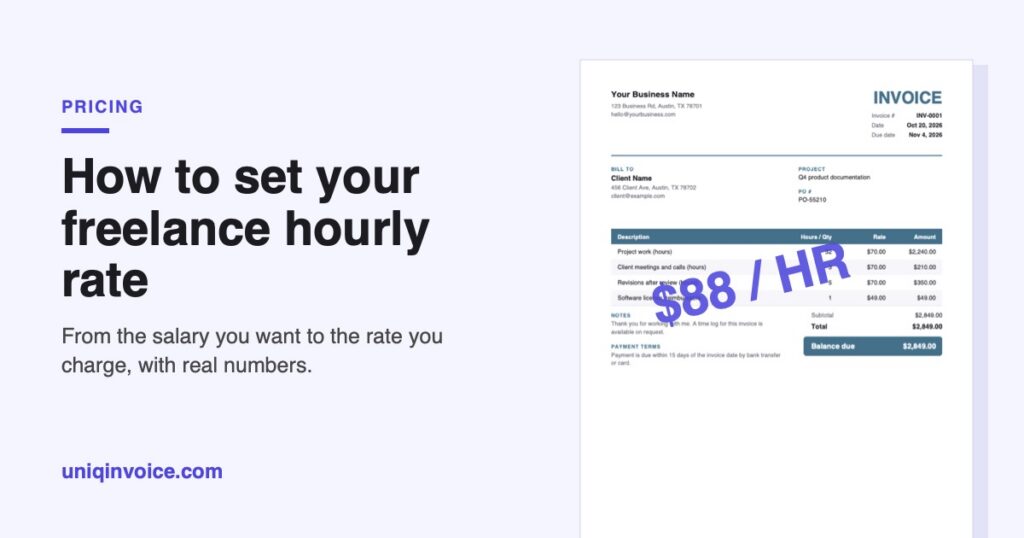
| Hourly rate | about $88 |
That’s more than double the $41 you started with, and it still assumes every billable hour gets booked. Work rarely comes in that evenly. Adding 10 to 15 percent for slow months and late payers puts you closer to $100 an hour, which happens to match a rule of thumb many freelancers use: divide the salary you want by 1,000.
Check the number against your market
The formula tells you the lowest rate that works for you. It doesn’t tell you what clients in your field will pay. Look at what other freelancers with similar experience publish on their sites, ask peers you trust, and pay attention to how prospects react to your quotes. If nobody ever pushes back, you’re probably too cheap. If almost everyone does, you may be pitching the wrong clients, or your rate may be ahead of your portfolio.
If the market rate in your niche is well below what your math says you need, that’s worth knowing early. You can specialize, target bigger clients, or change how you price, but you can’t make a $50 market pay for a $90 business for long.
Turn the hourly rate into project prices
Many clients prefer a fixed price, and many freelancers earn more with one. Your hourly rate is still the starting point. Estimate the hours, add a buffer for revisions and surprises (25 percent is a sensible default until you have your own history), and multiply. A job you expect to take 30 hours becomes 37.5 hours at $100, so you’d quote $3,750.
Then track the hours you actually spend, even on fixed-price work. After five or six projects you’ll know whether your estimates run short, and by how much.
Mistakes that keep rates too low
The most common one is pricing against the cheapest freelancers on a global marketplace. Someone charging $15 an hour may live somewhere with a fraction of your rent, or may be gone in six months. Their rate tells you very little about what your clients will pay you, especially if you work with local businesses that want someone who answers the phone.
Close behind: never raising rates. Costs go up every year, and so does your skill, but a rate set in your first month tends to stick unless you change it on purpose. Discounts for “exposure” and open-ended revisions do the same damage more quietly. If you agree to unlimited changes on a fixed price, your effective hourly rate drops with every round.
Putting your rate on an invoice
For hourly work, list the hours and the rate on separate lines by type of task, such as design, revisions and meetings, so the client can see where the time went. Our freelance invoice template has an Hours column and works out the totals, and the consulting template is set up for longer engagements. For bigger projects, take part of the fee up front; our guide on how to ask for a deposit has the wording.
Quick answers
Should I charge by the hour or by the project?
Hourly is safer when the scope is unclear or likely to change. Project pricing is better when you know the work well, because getting faster raises your effective rate instead of lowering your invoice. Many freelancers use both, depending on the job.
How do I raise my rates with existing clients?
Give notice, usually 30 to 60 days, and a date when the new rate starts. Raising rates for new clients first is an easy way to test a higher number before you change it for everyone.
Do I have to show my hourly rate to clients?
Only if you bill by the hour. On fixed-price work you can quote the project total, which keeps the conversation on the result rather than on the time it took.
Run this math once a year, or whenever something big changes. A new health insurance premium, a better laptop or a few slow months can move the result more than you’d expect, and raising a rate by five dollars is a much easier conversation than raising it by twenty.