What to Say When a Client Asks for a Discount (7 Replies)
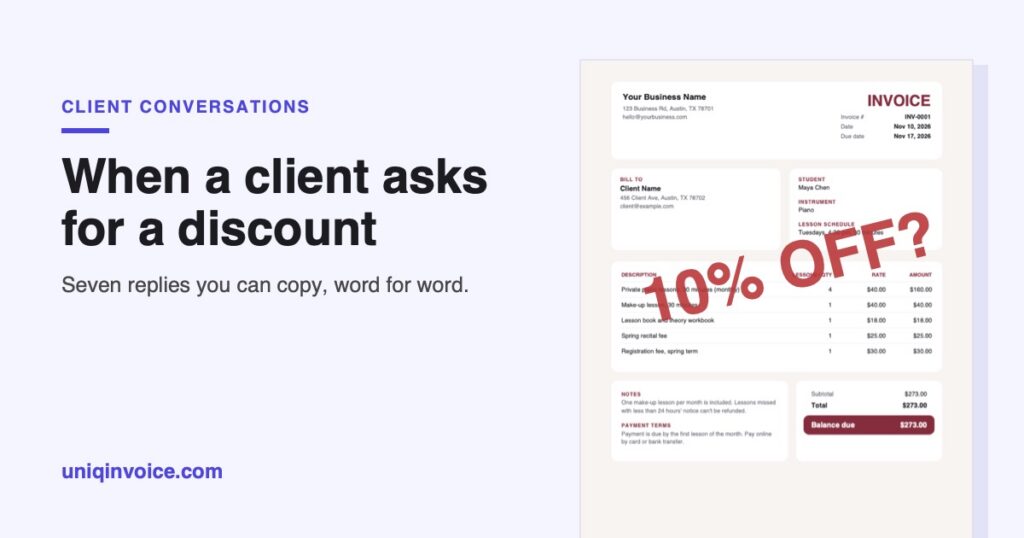
Sooner or later a client asks you to lower your price. It might come before you start, halfway through, or on the day the invoice lands. Being asked is normal. How you answer is the part that sticks, because the first price you drop becomes the price that client expects next time.
Below are seven requests you’ll probably hear, each with a reply you can copy and adjust. None of them is a flat no. They keep the conversation going while protecting your rate, and most of them trade something for the discount instead of giving it away.
1. “Can you do it for less?”
This one is often a test. Plenty of buyers ask on every quote, and they don’t always have a number in mind. Ask what budget they’re working with, then change the scope to fit it rather than doing the same work for less money.
“Possibly. What budget did you have in mind? Tell me the number and I’ll show you what I can do for it. Usually that means simplifying or dropping one part of the project.”
If they come back with a figure, send a revised quote with the smaller scope written out. Then they’re choosing between two clear options, not haggling over one.
2. “Someone else quoted us half that.”
Don’t criticize the other quote, and don’t rush to match it. Two quotes for “a website” or “a kitchen remodel” can describe very different jobs. Find out what’s actually in theirs.
“That’s worth comparing properly. Could you send me what their quote includes? The difference is often in the scope, the number of revisions or what you own at the end. If it really is the same job, they might be the better fit for this one, and that’s completely fine.”
Being willing to let the work go is the strongest position you can take here. Clients can tell when you mean it.
3. “Our budget is really tight this year.”
Sometimes it’s true, especially with small businesses and nonprofits. You can help without cutting your rate for good. A named discount with clear limits, a project split into phases, or a payment plan all lower the pressure on their budget.
“I understand. I offer registered nonprofits 15% off, and I’m happy to apply that here. Another option is to split the project in two, so the second half falls into your next budget year.”
A discount with a name and a reason is easy to repeat for the next nonprofit and easy to refuse for everyone else.
4. “Give us a deal and there’ll be plenty more work.”
Future work is a promise, and the discount they want is today. Flip the order. Keep the first project at full price and tie the discount to the work actually arriving.
“I’d love to keep working together. Let’s do this first project at the normal rate. If we book three more before the end of the year, I’ll take 10% off everything from the third one on.”
5. “It only took you two hours. Why is it $800?”
This comes up on fixed-price work, usually after the client sees how quickly you delivered. The price was for the result. The speed comes from years of doing the same thing, and that’s part of what they paid for.
“The price was for the finished work we agreed on, not for the hours. It went quickly because I’ve done this kind of project many times. If you’d rather be billed by the hour next time, I’m happy to quote it that way at $150 an hour.”
Once clients see the hourly math, the conversation usually ends there. If you need help setting that number, our guide to calculating your hourly rate walks through it.
6. “Can you take 10% off this invoice?”
Asking after the work is done is a different situation. The price was agreed and the job is finished, so the honest answer is to keep it. If the real problem is cash, offer a way to pay that eases it without changing the total.
“The invoice matches the quote we agreed on, so I’ll keep the amount as it is. If paying it all at once is hard right now, I can split it into two payments, half this week and half in 30 days.”
Put the payment plan in writing and send two invoices, or one invoice with a partial payment recorded. If the payments stop coming, our plan for unpaid invoices picks up from there.
7. “We’ll pay today if you knock 5% off.”
This one can actually work in your favor, since money today is worth more than money in 30 days. Five percent is steep for a few weeks, though. A standard early payment discount gives you the same speed for less.
“Paying quickly really helps, thank you. I offer 2% off on any invoice paid within 10 days, so I can do that here. After that, the full amount is due in 30.”
That’s “2/10 net 30” in billing shorthand. Our invoicing glossary explains it along with the other terms you’ll see on invoices.
When saying yes makes sense
A discount isn’t always a mistake. A slow month, a client whose name would help your portfolio or a long retainer can all justify one. Just make sure you get something back for it. That could be a bigger scope, payment up front, a longer commitment or a testimonial you can use. Asking for a deposit in exchange for a lower price is one of the easiest trades to make, because it cuts your risk at the same time.
Put every discount on the invoice
However you agree to it, show the discount as its own line instead of quietly lowering your prices. The client sees the full value of the work, and next time the discount isn’t assumed. A short label helps, such as “Nonprofit rate, 15%” or “Early payment, 2% if paid by March 14.” Every one of our free invoice templates has a discount field that does the math for you, from the freelance template to the new music lessons template.
And when a client asks for a lower price before the work even starts, put your answer in a quote with an expiry date. Our guide to estimates, quotes and invoices explains why that small detail saves arguments later.