Client Won’t Pay an Invoice? A Day-by-Day Plan to Get Paid
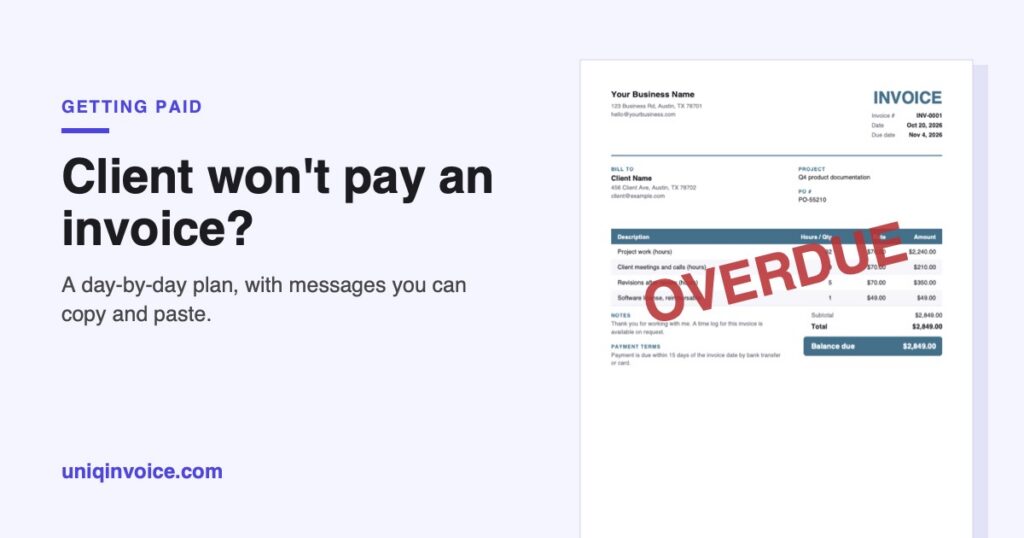
The invoice went out on the 1st and was due on the 15th. It’s now the 29th. The client hasn’t paid, and they’ve stopped answering email.
When a client won’t pay an invoice, the temptation is to fire off an angry message or to do nothing and hope. Both cost you money. Most late invoices do get paid, as long as you push in the right order: polite first, then specific, then formal. Skip ahead to threats and you can lose a good client who only lost your email. Wait too long and the debt gets harder to collect every week.
Below is the schedule we’d use, counted from the due date, with messages you can copy and paste. Further down we cover small claims court and collection agencies, for the cases that get that far. One caveat. This is practical advice, not legal advice, and the rules on late fees and collections differ from state to state.
First, figure out why it’s late
Usually the reason is boring. Sometimes it never arrived: a typo in the email address, a spam filter, a contact who left the company. At larger clients it may be sitting in an approval queue, waiting for a second signature or a PO number nobody gave you. Sometimes the client disagrees with a line item and hasn’t said so, or they’re short on cash this month and hoping you won’t chase it for a while. Only occasionally are they trying to avoid paying, and you’ll usually notice that because the calls stop being returned.
One short question clears up most of these: “Did the invoice reach the right person?” If the answer is a complaint about the work, sort that out before anything else. Mentioning late fees in the middle of a dispute just digs everyone in deeper.
What to send, day by day
Keep everything in writing, even after a phone call. If this ends up in front of a judge, your emails are your evidence.
Day 1 after the due date: a friendly nudge
Assume it slipped through the cracks. Attach the invoice again, and put the invoice number and amount in the subject line so the email is easy to find later.
Subject: Invoice INV-1042 for $2,480 was due yesterday
Hi Dana, a quick reminder that invoice INV-1042 for $2,480 was due on March 15. I’ve attached it again in case it got buried. You can pay by card or bank transfer from the link on the invoice. Thanks, Sam
Day 7: call
An email is easy to ignore. A two-minute call isn’t. Ask when you can expect payment and whether anything is holding it up, write down the answer and the name of the person who gave it, and send a two-line email that confirms what they told you. If they gave you a date, it’s now in writing.
Day 14: firm and specific
Now spell out what happens next. If your contract allows a late fee or lets you stop work, say so once, without drama.
Subject: Second reminder: INV-1042 is 14 days overdue
Hi Dana, invoice INV-1042 for $2,480 is now 14 days past due. Can you tell me by Friday when it will be paid? As our agreement says, work on the next phase is on hold until the account is current, and overdue balances carry a late fee of 1.5% per month. Sam
Stopping work is often the strongest lever you have. Use it. Don’t keep delivering to someone who hasn’t paid for the last delivery.
Day 30: the final notice
A final notice should read like one. Give a date, state the full amount including any agreed late fee, and say what you’ll do if the date passes. Then follow through. A deadline you don’t enforce teaches the client to ignore the next one.
Subject: Final notice: INV-1042 ($2,517.20) due by April 21
Hi Dana, invoice INV-1042 is now 30 days overdue. With the late fee in our agreement, the balance is $2,517.20. If I haven’t received payment by April 21, I’ll refer the account to a collection agency or file in small claims court. I’d much rather sort this out with you directly, so if something’s wrong with the invoice or you need a payment plan, reply before then. Sam
Day 45 and later: demand letter, then court or collections
A demand letter is the formal version of the final notice. Send it by certified mail as well as email, so you can prove it arrived. Plenty of business owners write their own. A letter from a lawyer costs more, but it often gets a faster reply. It tells the client you’re ready to file.
Small claims court: when it’s worth it
Small claims court was made for this: a clear debt, good paperwork and, in most states, no lawyer needed. What matters is the dollar limit, and it varies a lot.
| State | Small claims limit | Source |
|---|---|---|
| California | $12,500 for individuals and sole proprietors, $6,250 for other businesses | Marin County Superior Court |
| Texas | $20,000 (justice court) | Texas State Law Library |
| New York City | $10,000 | New York State Courts |
Limits change, so check your state’s court website before you file, and bring everything: the contract or written agreement, the invoice, your reminders and anything the client sent back.
Something people often find out too late: a judgment in your favor isn’t the same as money in your account. If the client still doesn’t pay, you may have to go back to the court to enforce it, for example with a bank levy or wage garnishment. How that works depends on your state.
What collection agencies charge
Most agencies work on contingency, so you pay nothing unless they collect. The cut is what you need to think about. It can be as low as 10 percent for a large debt handed over early and 50 percent or more for small, old ones, according to Fox Business. At 30 percent, a $1,500 invoice puts $1,050 in your pocket.
That trade makes sense when the client has gone silent for good and you’ve written off the relationship. It rarely makes sense at day 30.
Set up the next job so this doesn’t happen again
Collecting is far easier when the rules were agreed before the work began. What helps most:
- Write the payment terms into the contract: due date, late fee, and what happens to the work if a bill goes unpaid. Our post on invoice payment terms compares the usual options.
- Ask new clients for a deposit. A quarter to half up front is normal for project work, and our guide on how to ask for a deposit has wording that doesn’t feel awkward.
- Send the invoice the day the work is done, not at the end of the month.
- Let people pay by card or bank transfer. Every extra step is an excuse to wait.
- Automate the reminders, so they go out even on the weeks you’re too busy to think about it.
If you need an invoice to start from, our free invoice templates have a payment terms box and download as a PDF in a few minutes. There are versions for freelancers and contractors, among others. For more reminder wording, see our invoice email samples.
Quick answers
Can I add a late fee to an unpaid invoice?
Usually only if the client agreed to it beforehand, in your contract or in the terms printed on the invoice. Many states also cap how much interest you can charge, so check your state’s rules before you pick a rate.
How long should I wait before sending an invoice to collections?
There’s no fixed rule. A common rule of thumb is around 90 days past due, after a final notice that went unanswered. The longer a debt sits, the harder it is to recover.
Can I sue a client for not paying an invoice?
Yes. If the amount is under your state’s small claims limit, small claims court is the simplest route. For bigger amounts, talk to a lawyer about civil court.
Most clients who pay late aren’t trying to stiff you; they’re busy, disorganized or short on cash for a few weeks, and they’re counting on you to be patient. A calm, predictable follow-up gets those invoices paid without burning the relationship. And for the rare client who really won’t pay, you’ll have every email you need.