Invoice Examples: 3 Before-and-After Fixes That Get You Paid

Most invoices that get paid late aren’t wrong. They’re missing something the person paying needs, like a date to pay by or a reference the accounts team can match. Below are three common ones as they often go out and as they work better, with each change numbered on the image. Tap or click an image to see it full size.
1. One line, no due date: a freelance invoice
A designer finishes a rebrand and sends this. It’s friendly. Technically, it’s even an invoice. His client opens it, sees $2,400 for “design work” with no due date, and moves it to the pile of things to deal with later.
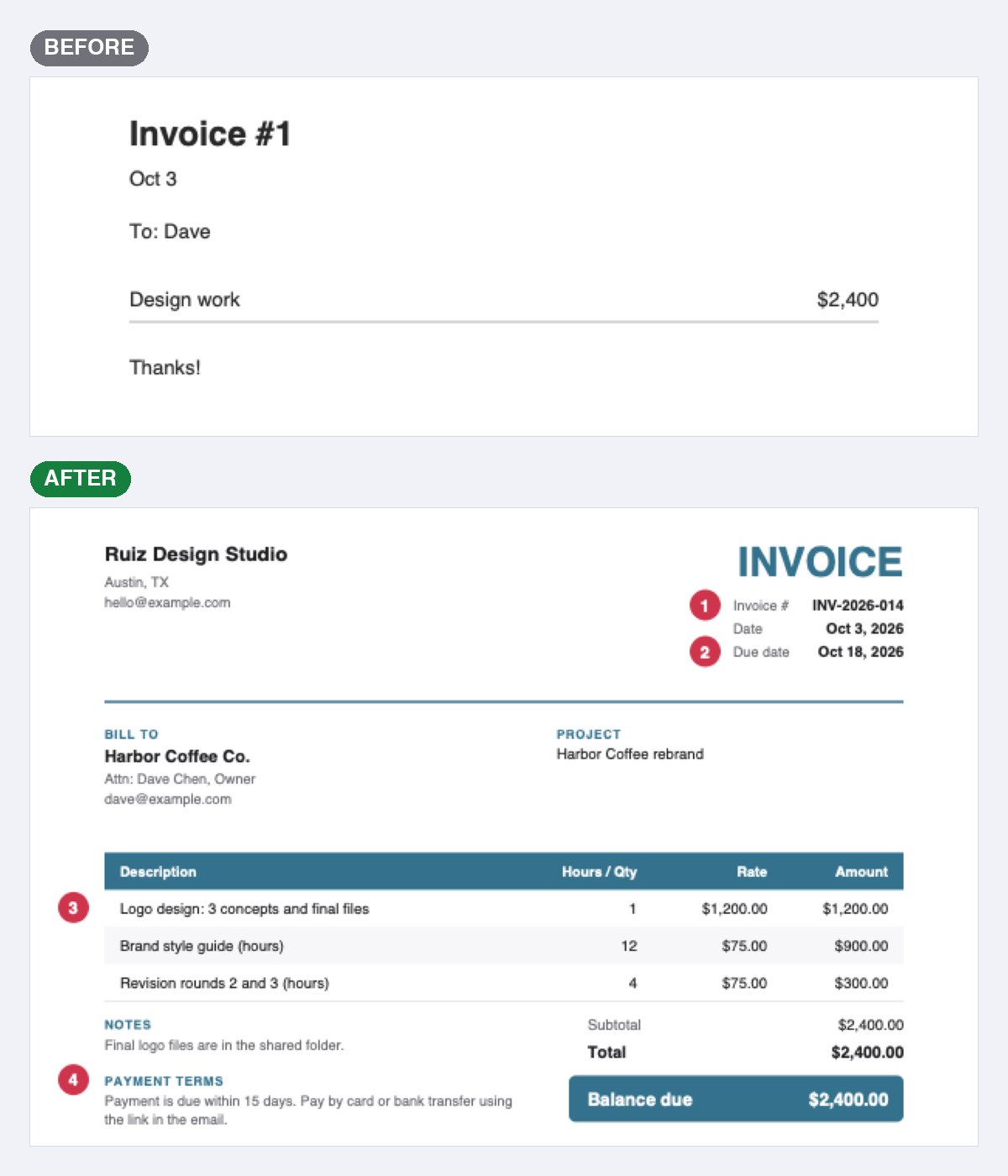
The first fix is the invoice number (1). A “#1” tells the client this is your first invoice and will clash with the next client’s #1 in your own records, while INV-2026-014 sorts by year and is easy to search for. Our guide to invoice numbers covers a few other schemes. Just below it is a due date (2). Without one there’s nothing to be late against, and fifteen days after the invoice date is a common choice for freelance work.
Splitting the work into lines (3) shows that the $2,400 covers a logo, a style guide and two extra rounds of revisions, so the client has nothing to ask before approving it. And where the old version said thanks, the terms now say how to pay (4). Name the methods you accept and where to find the link.
2. When the balance doesn’t add up: a contractor invoice
The homeowner remembers a $24,000 quote and a $6,000 deposit, so she expects to owe $18,000. Instead, the invoice says $18,500 and nothing else. That extra $500 is a change order she approved by text three weeks ago. On this invoice it looks like a mistake. So the whole payment waits until someone explains it.
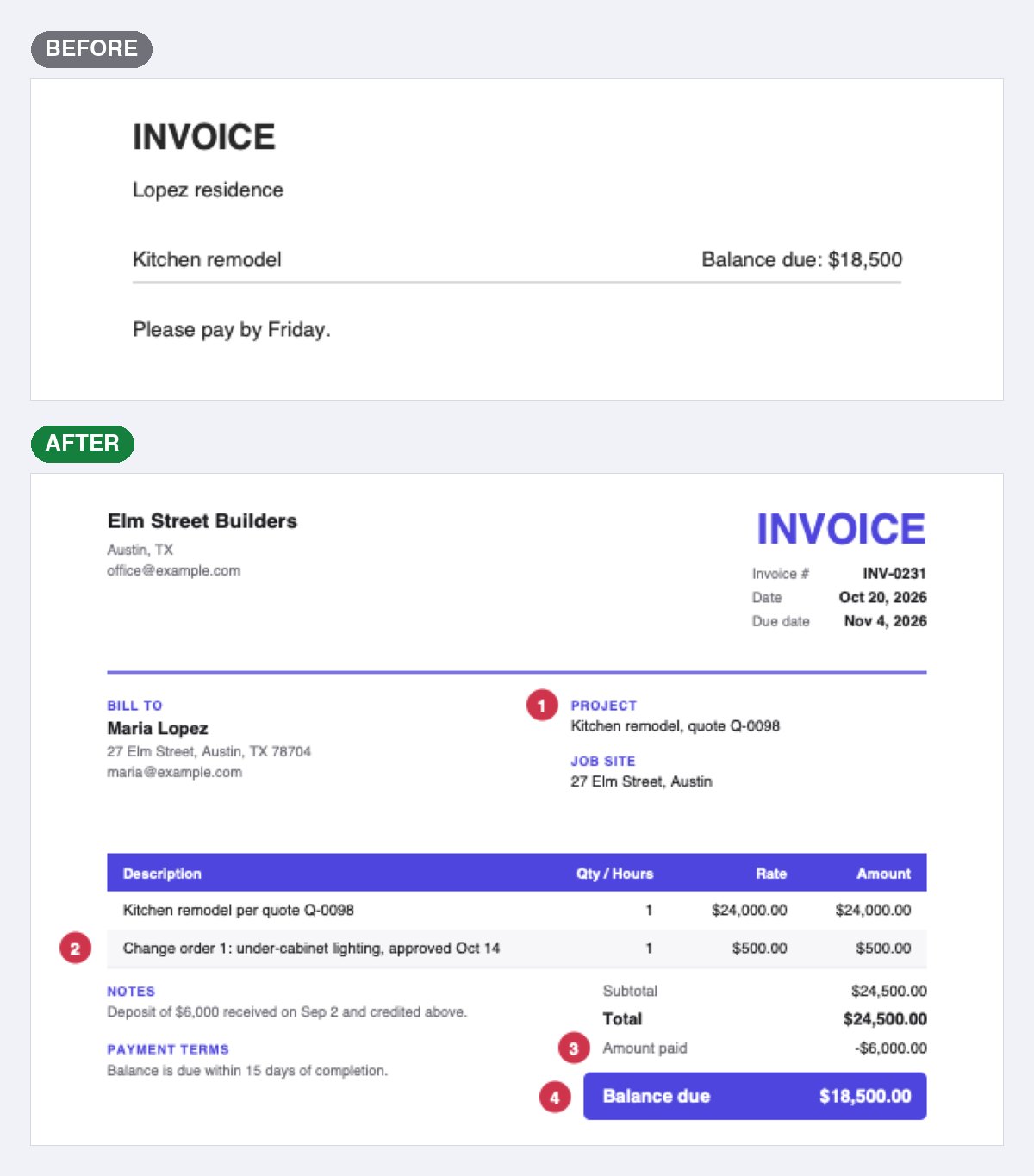
Putting the quote number on the invoice (1) lets her pull up the agreement it’s based on. Now the change order has its own line with the date she approved it (2), which answers the question before she reaches for the phone. Her deposit appears as a payment already received (3) rather than being quietly subtracted, and the balance (4) is something she can check herself: $24,500 minus $6,000.
If you take deposits regularly, our guide on how to ask for a deposit covers how to show them on the final bill, and estimate vs quote vs invoice has more on change orders.
3. Stuck in accounts payable: a consulting invoice
A consultant bills a company for a month of work and sends the invoice to the manager who hired him, addressed to her by name. She forwards it to accounts payable, and that’s where it stops. Their system needs a purchase order number. And the customer name has to match the company on the contract. Weeks go by before anyone tells him.
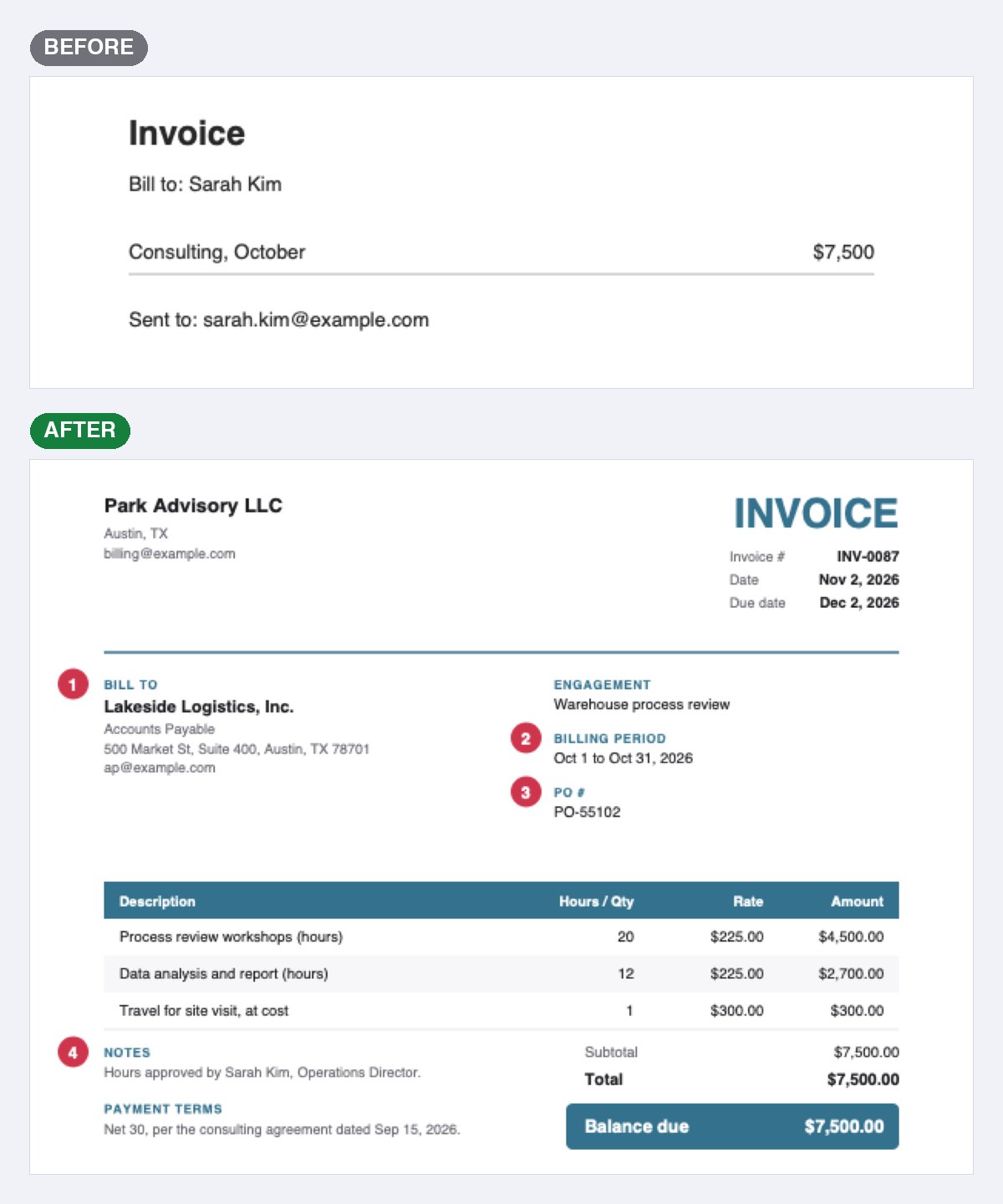
This time it’s billed to the company’s legal name, care of accounts payable, at the address and email they gave him (1). Writing out the billing period (2) helps when you invoice the same client every month. A PO number (3) is there because many larger companies match every invoice to a purchase order and hold the ones without it. One line in the notes says who approved the hours (4), so nobody in accounts payable has to chase the manager.
Before the first invoice to a new company, ask how they want to be billed: the legal name, the address, whether they use purchase orders, and whether they need a Form W-9 from you. US companies usually ask for one before they pay a new vendor, and sending it with the first invoice saves a round of email.
A 30-second check before you send
None of the fixes above took more than a minute. If an invoice is missing one of these, it usually comes back with a question instead of a payment:
- a unique invoice number and the invoice date
- a due date on the invoice itself, not just in the contract
- the client’s correct name and the right contact for payment
- any reference they need, such as a quote number, PO number or project name
- line items that someone outside the project could understand
- deposits and earlier payments shown as already paid
- exactly how to pay, with a link or bank details
The fixed versions above were made with our free freelance, contractor and consulting templates, which already have fields for most of this list. If your customers still pay by check, the pest control template adds a tear-off payment stub, so each check comes back with the invoice number attached. You’ll find the rest in the invoice templates by industry.
And if an invoice is already overdue, our day-by-day plan for unpaid invoices picks up from there.