Invoice Due Date Calculator: Net 15, 30, 60 and More
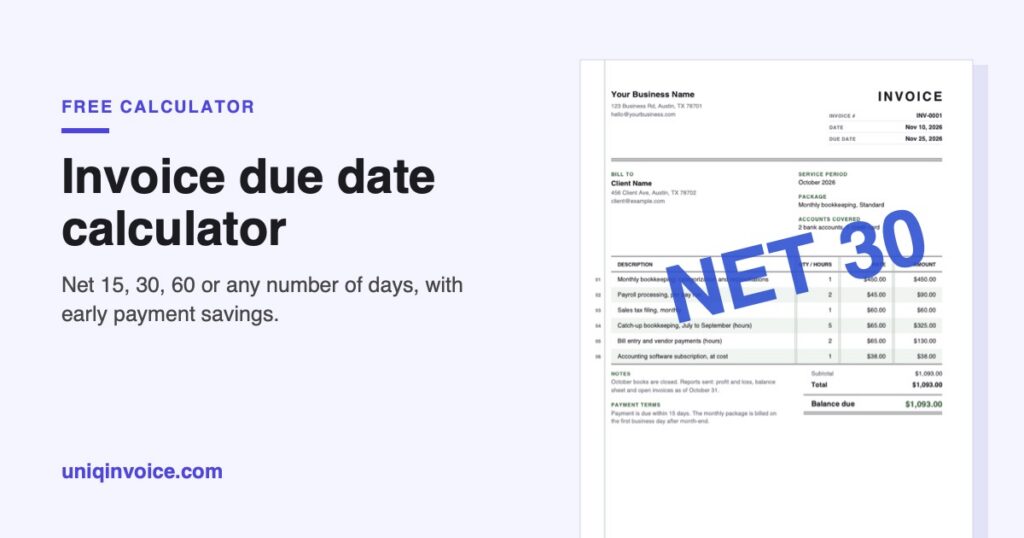
Pick your invoice date and payment terms, and you’ll see the exact due date and how many days are left. Add an amount and a discount if you want to know what paying early would be worth. It all runs in your browser, so nothing you type is sent or saved.
| Terms | Due date |
|---|
How net terms are counted
“Net 30” means the full amount is due 30 calendar days after the invoice date. Day one is the day after the invoice date, and weekends and holidays count like any other day, so an invoice dated March 3 on net 30 is due April 2. Net 15 or net 60 works the same way with a different number.
Some businesses use end-of-month terms instead, written as “net 30 EOM.” There the count starts at the end of the month the invoice was issued, so that March 3 invoice wouldn’t be due until April 30. If a client asks for EOM terms, put the resulting date on the invoice so nobody has to work it out.
What if the due date falls on a weekend?
There’s no single rule for private invoices. Your contract decides, and plenty of businesses simply treat the next business day as the deadline. You can skip the question by writing a weekday on the invoice. The calculator flags weekend dates and suggests the Monday after.
Which terms should you use?
Shorter terms usually mean faster payment, so start short and only lengthen them when a client asks. Due on receipt suits one-off jobs and individual customers. Net 15 is common for freelancers, while net 30 is what many companies expect. Large organizations sometimes insist on net 60 or longer because their payment runs follow a fixed schedule. If a client wants longer terms, it’s fair to ask for a deposit in return; our guide on how to ask for a deposit has the wording.
What an early payment discount really costs
“2/10 net 30” lets the client take 2% off if they pay within 10 days. Otherwise the full amount is due in 30. Two percent sounds small. For a client with cash on hand, though, paying 20 days early to save 2% works out to an annual return of roughly 37%, and that’s why accounts payable teams keep an eye out for these terms. For you, it costs 2% of the invoice and gets the money into your account about three weeks sooner.
That trade makes sense when cash is tight or a client tends to pay late. On thin margins, it usually doesn’t. If a client asks for a discount for some other reason, our replies to discount requests can help.
Put the date on the invoice, not just the terms
“Net 30” leaves the client to count. A due date doesn’t. Write both, for example “Due December 23, 2026 (net 30),” and whoever pays the invoice knows exactly when it’s due, even if they’ve never seen your contract. Every one of our free invoice templates fills in the due date for you from the invoice date. You’ll find the other billing terms in the invoicing glossary, and if the date passes without a payment, our day-by-day plan for unpaid invoices picks up from there.