What is a legal invoice?
A legal invoice is the bill an attorney or law firm sends to a client for legal services on a matter. It lists the work performed during the billing period, the time spent and the rate, any flat fees, and the costs the firm advanced on the client’s behalf. Because clients often review legal bills line by line, a clear and well-organized invoice builds trust and reduces questions.
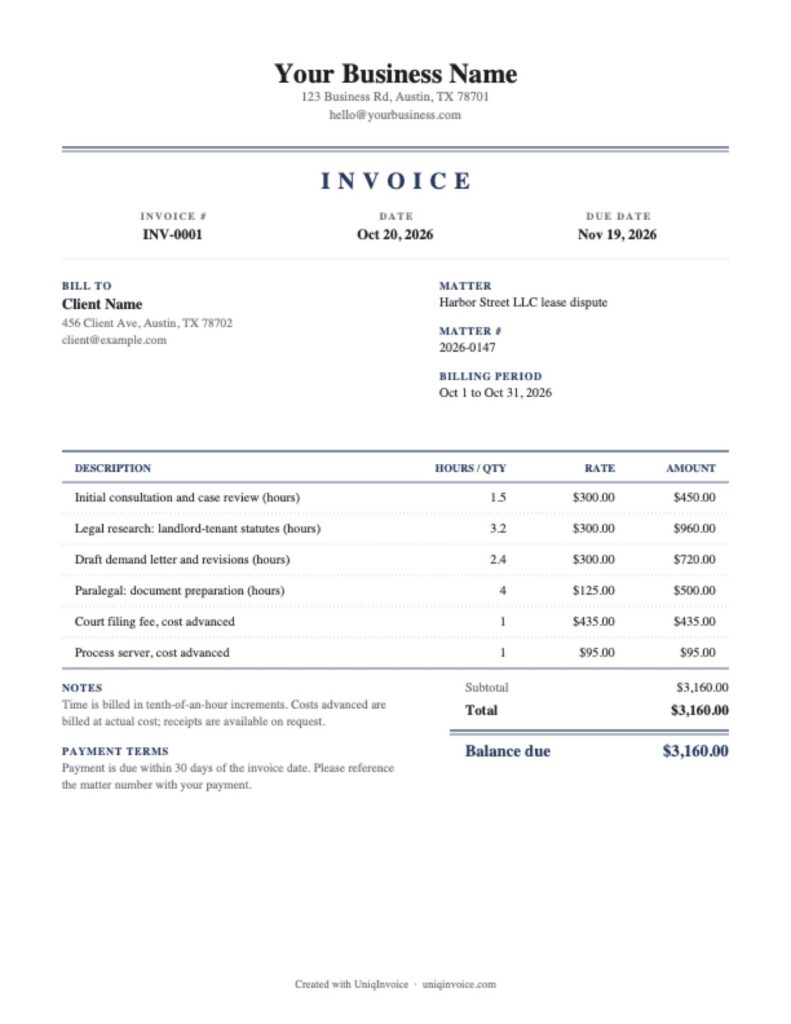
This free template uses a classic letterhead design suited to law firms, with fields for the matter name, matter number and billing period. It separates fees from costs advanced and calculates totals and the balance due automatically.
What to include on a legal invoice
- Firm details: firm or attorney name, address, phone, email and website.
- Client and matter: the client’s billing details, the matter name and the matter or file number.
- Invoice number and dates: a unique number, the invoice date, the due date and the billing period.
- Time entries: a description of each task with hours and rate, grouped by attorney or paralegal where helpful.
- Flat fees: fixed prices for defined services, such as drafting a will or forming an LLC.
- Costs advanced: filing fees, process servers, court reporters, copies and similar expenses.
- Payments and trust funds applied: amounts already paid or applied from a retainer.
- Payment terms: the due date, payment methods and the matter number to reference.
How to fill out this legal invoice template
- Add your firm’s logo and contact details at the top of the letterhead.
- Enter the client, the matter name, the matter number and the billing period.
- Check the invoice number and dates. The due date is set 30 days ahead.
- Replace the sample entries with your time entries, flat fees and costs advanced.
- Enter any retainer or trust funds applied in Amount paid, and note the source in the notes.
- Review the notes and payment terms, then download the PDF.
Common billing methods for law firms
Hourly billing
The traditional method for litigation and advisory work. Time is usually recorded in tenth-of-an-hour increments, with a clear description of each task.
Flat fees
A fixed price for a defined service, common for estate planning, business formation, immigration filings and real estate closings. Clients appreciate knowing the cost up front.
Retainers
Many firms ask for an advance payment held in a client trust account and applied to invoices as work is done. Show the amount applied on each invoice and keep trust records separate, following your state bar’s rules.
Contingency fees
Some matters, such as personal injury cases, are billed as a percentage of the recovery. These invoices usually list the settlement, the fee and the costs deducted, as set out in the fee agreement.
Writing clear time entries
Good descriptions explain what was done and why it mattered, for example “Draft demand letter to landlord regarding security deposit” rather than “Letter”. Avoid grouping many tasks into one block of time, list paralegal work separately at its own rate, and keep entries consistent with the scope in your engagement letter. Clients pay faster when they can see exactly what they are paying for.
Tips to get paid faster
- Bill on a regular schedule. Monthly invoices are easier for clients to review than one large bill at the end of a matter.
- Separate fees from costs. Listing costs advanced on their own lines answers questions before they are asked.
- Reference the matter number. It helps business clients route the invoice to the right approver.
- Follow up early. A short reminder before the due date keeps receivables from aging.
UniqInvoice helps attorneys send professional invoices, track payments by client and send automatic reminders, from a phone or computer.