What is a property management invoice?
A property management invoice is the bill a property manager sends to a property owner for managing rental units. It covers the monthly management fee and any additional services, such as finding tenants, renewing leases, inspections and coordinating repairs. Owners rely on these invoices to understand the cost of running their property, so clear line items and supporting documents are essential.
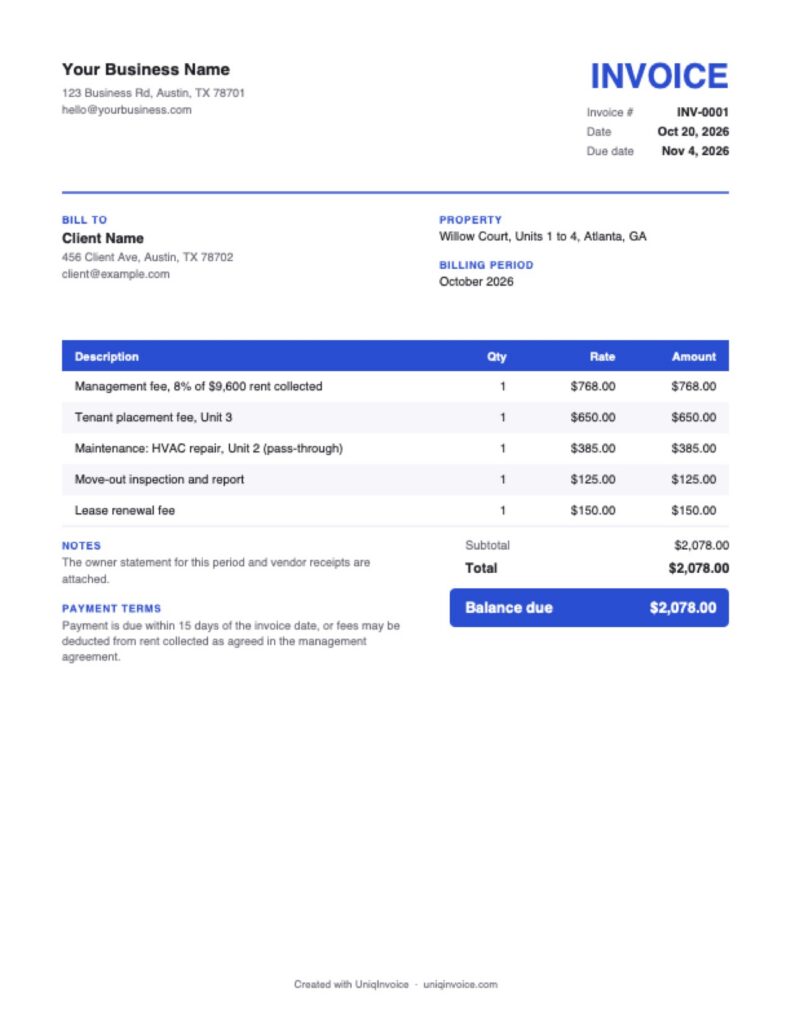
This free template includes the property and billing period, shows how the management fee was calculated, and separates fees from pass-through maintenance costs.
What to include on a property management invoice
- Your company details: name, address, phone, email and license number where required.
- Owner details: the property owner or ownership entity you are billing.
- Property and billing period: the address or units and the month covered.
- Management fee: the percentage or flat fee and the rent it was based on.
- Leasing fees: tenant placement, lease renewals and advertising.
- Maintenance and repairs: each job with the unit and vendor, billed as a pass-through cost.
- Inspections and other services: move-in and move-out inspections, evictions or bookkeeping.
- Terms: the due date, or how fees are deducted from collected rent.
How to fill out this property management invoice template
- Add your logo and company details.
- Enter the owner, the property and the billing period.
- Check the invoice number and dates. The due date is set 15 days ahead.
- Enter the management fee, with the percentage and rent collected in the description.
- Add leasing fees, maintenance pass-through costs and inspections.
- Mention the attached owner statement and receipts in the notes, then download the PDF.
Common property management fees
Monthly management fee
Usually a percentage of rent collected, sometimes a flat fee per unit. It covers rent collection, tenant communication and routine oversight.
Leasing or tenant placement fee
A one-time fee for marketing the unit, screening applicants and signing the lease, often a portion of the first month’s rent.
Lease renewal fee
A smaller fee for renewing an existing tenant’s lease.
Maintenance coordination
Repairs are usually billed at cost with the vendor invoice attached, sometimes with an agreed coordination fee.
Owner statement vs. invoice
Property managers often send owners two documents. The owner statement shows all money in and out for the property: rent collected, late fees, repairs paid and the amount transferred to the owner. The invoice shows the fees the management company is charging for its services.
Many managers deduct their fees from collected rent and show them on the owner statement, while others send a separate invoice, especially when rent collected does not cover the costs. Either way, the numbers should match. Attaching the owner statement to the invoice, as noted in the sample, gives owners the full picture in one place.
Tips to get paid faster
- Match the management agreement. Use the same fee names and percentages the owner signed.
- Attach statements and receipts. Owners approve invoices faster when every cost is documented.
- Invoice monthly. A regular schedule aligned with rent collection is easy for owners to follow.
- Keep each property separate. Clear property and unit labels prevent confusion for owners with several rentals.
UniqInvoice helps property managers send recurring monthly invoices, track payments by owner and follow up automatically.