What is a software development invoice?
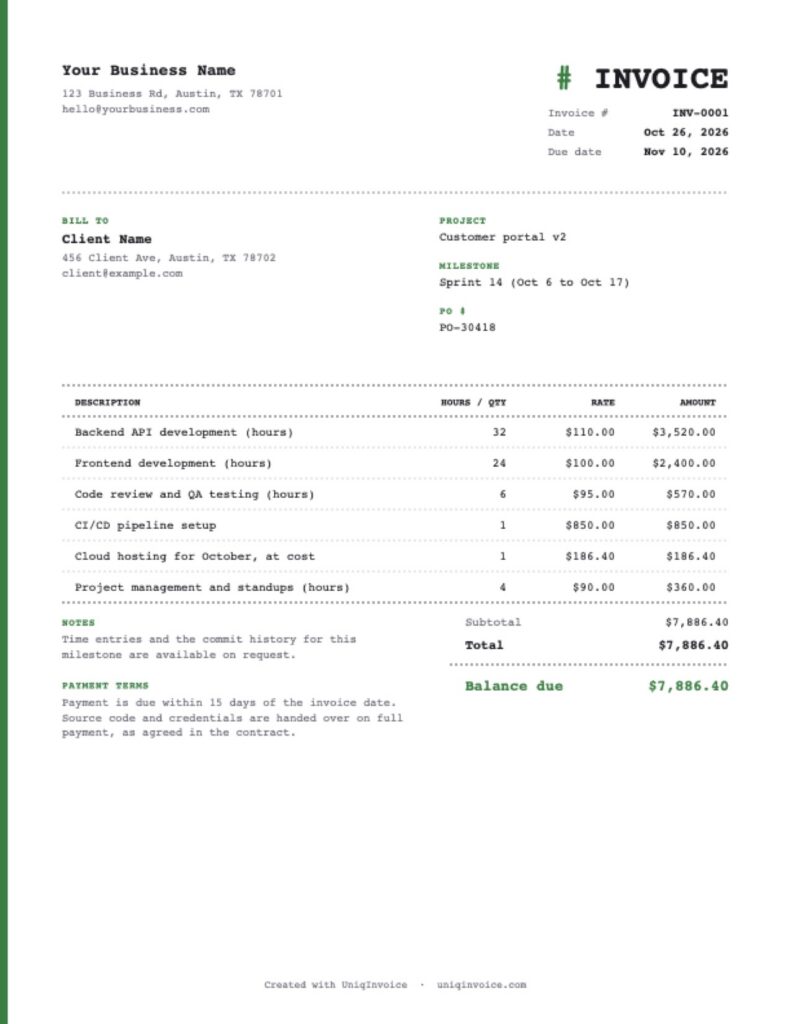
A software development invoice is the bill a freelance developer, development agency or IT contractor sends for building, maintaining or supporting software. It usually lists development hours by activity, fixed-price deliverables, and third-party costs such as hosting or licenses, and it often covers a sprint or milestone rather than the whole project.
This free template uses a clean monospace design that fits technical work. It includes fields for the project, the sprint or milestone and the client’s PO number, and it calculates totals and the balance due for you.
What to include on a software development invoice
- Your details: your name or company, website, email and tax ID if your clients need it.
- Client details: the company, billing contact and PO number.
- Project and milestone: the project name and the sprint, milestone or billing period.
- Development work: backend, frontend, mobile or integration work with hours and rates.
- Quality and delivery: code review, testing, deployment and DevOps tasks.
- Fixed-price deliverables: features or milestones billed at an agreed price.
- Third-party costs: cloud hosting, domains, APIs or licenses paid on the client’s behalf.
- Terms: the due date, payment methods and when code and credentials are handed over.
How to fill out this software development invoice template
- Add your logo and contact details.
- Enter the client, the project, the sprint or milestone and the PO number.
- Check the invoice number and dates. The due date is set 15 days ahead.
- Replace the sample lines with your hours by activity, fixed-price work and costs.
- Enter any deposit or retainer already paid in Amount paid.
- Review the notes and terms, then download the PDF.
Common pricing models for development work
Time and materials
Hourly or daily rates for the time actually spent. It suits evolving products and agile projects. Group hours by activity, such as backend, frontend and QA, so the client can follow where the time went.
Fixed price
An agreed price for a clearly defined scope or milestone. Clients like the certainty; protect yourself with a written scope and a change request process for anything extra.
Retainer
A monthly fee for a reserved number of hours or for maintenance and support. It gives you predictable income and gives the client priority access.
Make your invoice easy to approve
Technical clients and their finance teams read invoices differently. Engineering managers want to see what was built, and finance wants a PO number, a clear period and a total that matches the contract. Name each line in plain language, link the invoice to the sprint or milestone, and keep a time log or a list of completed tickets ready in case someone asks. Separating third-party costs from your own work also avoids questions about markups.
Tips to get paid faster
- Bill on a regular cadence. Invoice at the end of each sprint or each month instead of waiting for launch.
- Get the PO number first. Many companies cannot process an invoice without one.
- Tie handover to payment. Transfer code, credentials and rights after the final invoice is paid.
- Automate reminders. A short reminder before the due date keeps payments on schedule.
UniqInvoice helps developers send professional invoices, set up recurring retainers and follow up automatically on late payments.